

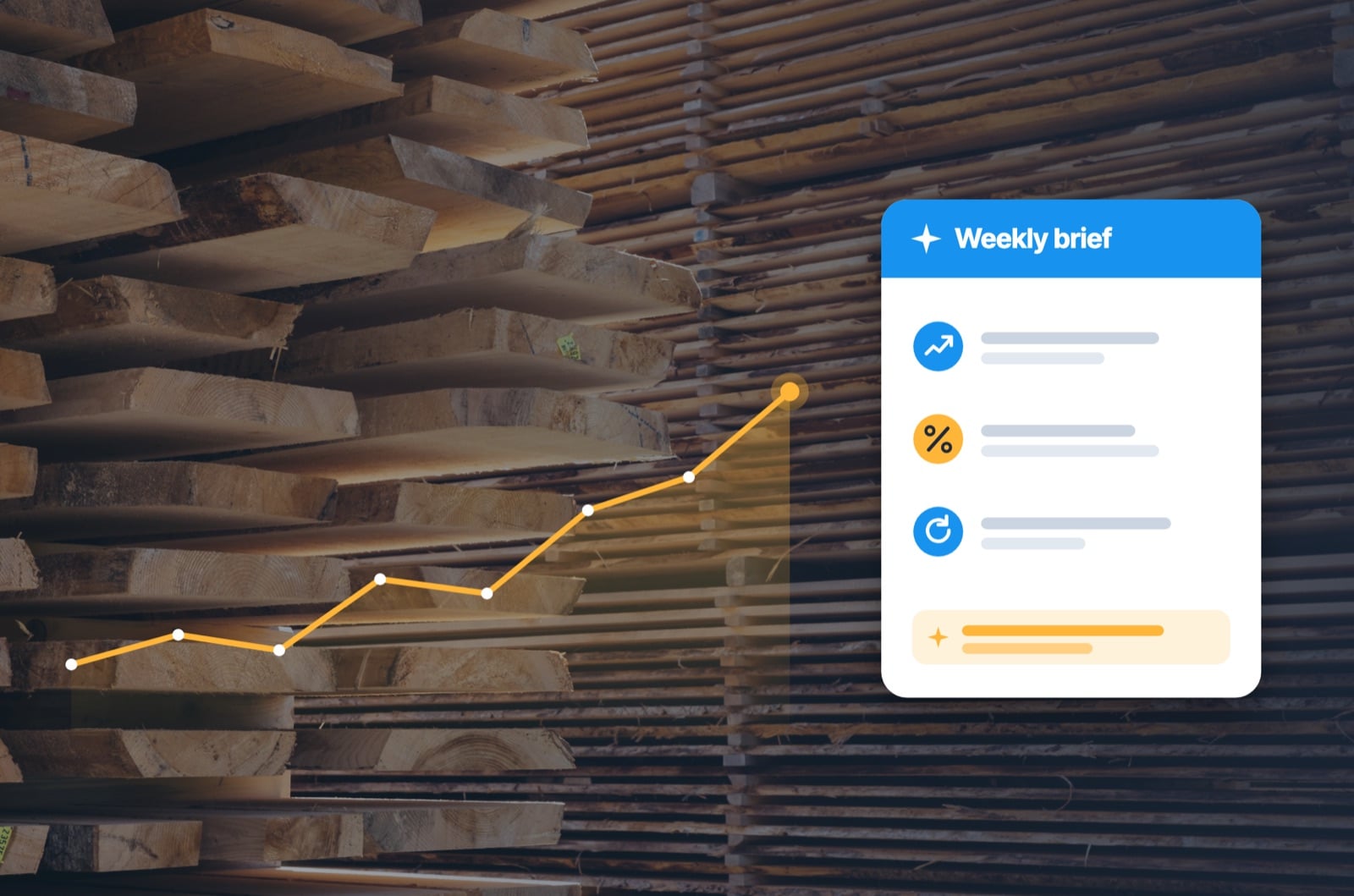
TL;DR: I connected my family's lumber yard to ChatGPT in one afternoon. Now our buyer gets a weekly brief on what's moving, what to reprice and what to reorder.
I work at Dataddo, and I spend most of my days talking to companies about AI and their data. So you'd expect the AI project I'm most excited about to be at a tech company. It isn't. It's at my family's lumber yard, which my dad and brother run.
The data was already there
Like most retailers, the yard runs on a point-of-sale system. Underneath it sits a Firebird database with a record of every sale.
That's a lot of knowledge about the business. But you can't just ask a database a question. Unless someone writes a query or builds a report, the answers stay inside it. And most family businesses don't have a data analyst on staff. Ours certainly doesn't.
What we did
We used Dataddo Data to AI to connect that Firebird database to ChatGPT. I got it set up in one afternoon, and after that we could start asking questions.
Now my dad and brother ask about sales and inventory in plain English.
The interesting questions aren't "what sold the most?" They're the ones that shape purchasing. Which products sell steadily enough that we could buy in bigger quantities and get a better price from the supplier? Which slow movers are tying up cash on the shelves?
A weekly brief for the buyer
Asking questions is only half of it. Every week, our lumber buyer now gets a brief that's generated automatically. It covers:
- Last week's big movers.
- Items selling at margins that are too low, so we can adjust the price.
- What to reorder.
Sometimes it goes further and suggests buying a specific item in bulk, because it knows we sell a lot of it and the supplier gives a price break at higher quantities.
That's the kind of analysis a bigger business would have someone on staff for. For us, it's reducing the money wasted on stock that sits on the shelves, and it's increasing our profit margins across the board.
Questions worth asking your own sales data
If you run a shop, a yard or a distribution business, here are a few more in the same spirit:
- Which items sell steadily all year, and which only in season?
- What hasn't sold in 90 days, and how much cash is in it?
- Which regular customers are buying less than they did last year?
- Where do we discount most, and does it actually bring more volume?
None of these need a dashboard built in advance. They need the data, and an assistant that understands it.
Why not just give ChatGPT the database?
There are other ways to do this, and I looked at them.
You can export last year's sales and upload the file. For a one-off look, that works. But an export is out of date the moment it's saved.
You can also connect an AI straight to the database. There are free, community-built MCP servers for Firebird that let an assistant list the tables and write its own SQL. The catch is that the AI then has to guess what every column means: whether returns are counted, which rows were voided, whether this month is finished. It usually guesses without telling you.
At Dataddo we measured how often that goes wrong. In our benchmark on NetSuite data, AI models working from raw access (a SQL connection or CSV exports) gave a confidently wrong answer 19% to 38% of the time. Through Data to AI, that fell to 5% to 13%. That test used a different system and Claude models, so it doesn't predict how a lumber yard's data will behave. But it's the same failure, and I didn't want my family making buying decisions on a confident guess.
How it works
- Dataddo connects to the database. Firebird is a supported source. A database that isn't on the internet can be reached through an SSH tunnel.
- The data syncs on a schedule. The AI reads the copy Dataddo collects, never the point-of-sale system itself, so a question can't slow down the till.
- The assistant picks, the server calculates. Data to AI serves the data as defined entities and metrics. The AI chooses what it needs; Dataddo builds the query.
- It's read-only. The AI can't change anything, sensitive fields such as names and emails stay hidden until someone allows them, and every question is logged.
- No data warehouse. No extra engineering. It works with ChatGPT, Claude and other AI assistants you already use.
You don't need a data team
Seeing what this does for my dad and brother made it personal for me. And the lesson isn't only for family businesses. Whether you run a lumber yard or a global company, the data you need for better decisions is usually already there.
You shouldn't need a big data team to ask better questions about your business.
Data to AI is priced per seat, and you can start with a free trial.
Header image based on a photo by Patrick Robert Doyle on Unsplash.